Does Smaller Tile Cost More to Install? 3x6 vs. 3x12
Changing from 3x12 subway tile to 3x6 doubles the piece count. Why a tile size change is a scope, price, and schedule review.

You picked a tile you love. Right color, right shape, exactly the look you had in your head for the bathroom.
Then your contractor tells you the new tile may change the price.
That can sound like a runaround. The wall did not get any bigger. The tile costs about the same per square foot. So why would the labor move?
The short answer
Yes, smaller tile can cost more to install, and the reason is piece count, not price per square foot.
That is not a rule that smaller is always pricier. It is the reason the tile named in your quote is part of the scope, the same way the niche and the layout are. Change it, and somebody has to re-check the labor, the materials, and the calendar before anyone starts setting tile.
I am writing this one because we learned it the expensive way.
Why we are writing this
We spec'd the wall tile as 3×12 white subway, running bond. The selection that came back was a 3×6, same width, half the length. Reasonable change. Nobody did anything wrong.
Except our quote priced the tile and stayed quiet about the labor. So when the smaller tile added layout, cuts, grout, and an estimated week of added time, we absorbed the difference. That was the right call, and it was our own fault. The quote made a promise about a number without naming the assumption the number was built on.
So we changed the quote instead of changing the story. This post is the homeowner-facing half of that fix.
The math: cut the length in half, double the piece count
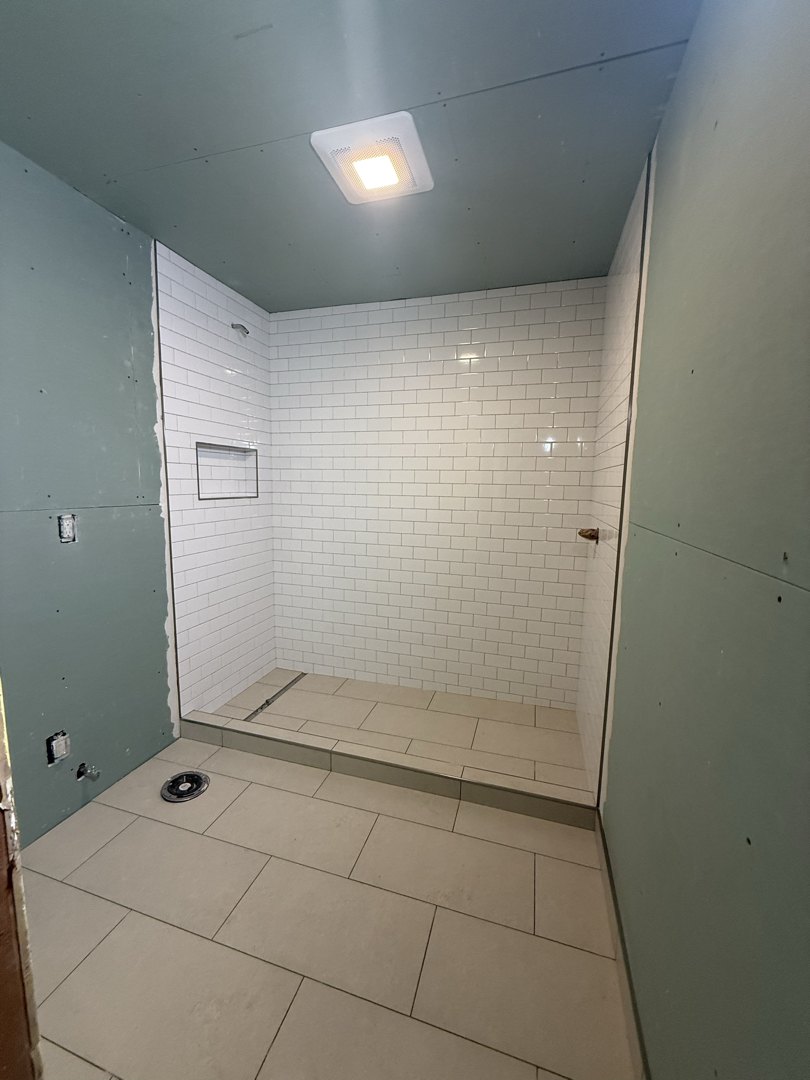
Our quote called for 3×12 subway tile. The tile that came back was 3×6. Same width, half the length.
- One 3×12 tile covers 36 square inches.
- One 3×6 tile covers 18 square inches.
- Two 3×6 tiles cover the ground of one 3×12.
one piece to set
two pieces, more joints
That also adds about twenty percent more grout joint across the same square foot, because every tile you add brings its own edges with it. Twice the pieces on a wall that never changed size.
On an 88 square foot tub surround, that is roughly 350 field tiles in 3×12 and roughly 700 in 3×6, before a single cut or any waste.
Go further down in size and it compounds fast. Against a 6×12, a 3×6 is a quarter of the face, so the same wall takes four times the pieces and twice the grout line. Small steps in nominal size are large steps in piece count.
That is geometry, not a price list. Your real quantities depend on the wall dimensions, the layout, the waste factor, the cuts, and the tile's actual dimensions rather than its nominal ones. But it makes the workload difference easy to see, and it is why "same square footage" is not the same job.
Where the extra labor actually comes from
1. Layout
A clean installation is decided before the first tile goes up. Where the grout lines land, how the field meets the corners, whether the cut pieces at each edge look balanced, how the lines carry across the back, sides, top, and shelf of a niche. More pieces means more lines to keep honest. A running bond adds another layer, because every row is offset from the one under it.
2. Setting and spacing
Every piece gets placed, spaced, aligned, and checked. Two small tiles do not take exactly twice as long as one large one, but they are two installation cycles instead of one, and the arithmetic only gets steeper as the tile gets smaller. Joints have to stay consistent across the whole wall, and a small drift shows up several rows later, usually somewhere you cannot hide it.
3. Cuts and details
Open field is the fast part. Valves, showerheads, benches, windows, and niches are the slow part. Each interruption is a cut and a transition, and a niche has inside corners, outside edges, a back, two sides, a top, and a shelf that all have to meet cleanly. Smaller tile puts more individual pieces into exactly the areas that were already the fussy ones.
4. Grout
More joints means more grout to mix, fill, tool, clean, and finish evenly. Grout reads as design when it is done well. It is labor either way.
When smaller tile does not cost more
Plenty of times, honestly.
A straightforward 3×6 backsplash can be simpler than a large format shower wall that needs the substrate flattened and two people to handle each tile. Mosaic sheets fly on one surface and crawl on another. Stone may need sealing or slower cutting. A demanding pattern can add labor to a large tile.
We do not price a bathroom off tile size. We price the exact tile and its actual dimensions, the area, the pattern and orientation, the grout joint width, the niches and fixtures, the edge treatment, the surface prep, and the handling. Which is exactly why a tile change needs a look rather than an assumption: the new selection might land higher, lower, or right where it was.
The rule: a tile size change is a scope change
Here is the part we put in writing after that job.
Tile dimensions, shape, pattern, orientation, grout joint width, edge treatment, and niche layout are quoted scope, not finish-only selections. Changing any of them after you accept the quote triggers a written scope, price, and schedule review. Changing 3×12 to 3×6 is on that list by name.
If the review moves the number or the calendar, you get a written change order first, showing what selection changed, what work is added or removed, the price adjustment, the schedule adjustment, and who has to approve it.
Revised work starts only after the person who signed the original quote approves that change order in writing. If it is not approved, we install the originally quoted selection when it is available, or we pause the affected work until the selection is settled. Nothing gets absorbed quietly and nothing gets billed as a surprise.
One caution on that week: it was our own estimate on one bathroom, one tile, one niche. It is not a conversion rate. Your delta gets priced for your job.
Size is not the only thing that changes the work
Two tiles can measure the same and still install differently. Handmade tile varies in thickness and shape. Heavy texture is harder to cut and harder to keep clean. A directional pattern costs planning and waste. A different grout joint or edge profile changes the finished detail and the labor to get there.
So a quote should name more than "wall tile." Manufacturer, collection, SKU, nominal size, actual size, pattern, grout joint width, grout color, edge treatment, niche layout, as far as those are known when we write it.
Can you check this yourself?
You can count pieces and ask sharper questions. Be careful with a flat per square foot comparison between bids, because square footage hides the niche, the cuts, the pattern, the prep, and the edges. Two contractors quoting "the same" wall may not be quoting the same work at all.
Best move: pick the tile before the quote is finalized, and make the tile you picked appear in the quote by name. If you want a sense of the ranges first, our tile cost calculator is a starting point, and our tile installation page covers how we scope the work.
Frequently asked questions
Does smaller tile cost more to install?
It can. Going from 3×12 subway tile to 3×6 halves the face of each tile, so the same wall takes about twice as many field tiles and about twenty percent more grout joint. Against a 6×12, a 3×6 takes about four times as many pieces. More pieces means more layout, setting, cuts, and grout labor. Smaller is not automatically more expensive, because pattern, prep, handling, and detail work also drive the labor.
Is changing tile size after signing a quote a scope change?
Yes. At DuetRight, tile dimensions, pattern, orientation, grout joint width, edge treatment, and niche layout are quoted scope, not finish-only selections. Changing any of them triggers a written scope, price, and schedule review, and a written change order approved by the person who signed the quote before the affected work begins.
How many 3×6 tiles equal one 3×12 tile?
Two. One 3×12 tile covers 36 square inches and one 3×6 tile covers 18 square inches. One 6×12 covers 72 square inches, so it takes four 3×6 tiles. This is area geometry for comparison, not a pricing formula.
Does the tile allowance in my quote cover a size change?
An allowance covers the material. It does not automatically cover the labor. If the new selection changes the piece count, the layout, or the schedule, that part gets reviewed and priced separately, in writing, before the affected work starts.
The takeaway
Choosing tile should be one of the good parts of a bathroom renovation, not a trapdoor.
Just know that going from 3×12 to 3×6 is not only a style change. Same wall, twice the pieces, more grout line, more layout, more cuts, more days. A real quote makes that assumption visible. A real change order reviews it before install. And a real contractor hands you the number before the work changes, not after.
If you are planning tile in Seattle, bring us the selection while the quote is still being built. That is the cheapest possible moment to change your mind.
Life is hard. Bathroom remodels should be easy.
Explore Recent Posts

Why Americans never used bidets, and why that is changing
Do you need an outlet for a bidet?