
Do you need an outlet for a bidet?
We asked one client about a bidet three times. The fourth question worked. What a bidet needs, and why the outlet is cheap now and costly later.

Why we are writing this
There is a thing that happens to people who get a bidet. They stop being normal about it. They bring it up at dinner. They become, frankly, a lot.
We know, because it happened to all of us.
So when a client of ours was doing three bathrooms with us this year, we asked him about a bidet. He said no. We asked again, with more people in the room and more enthusiasm than the situation called for. He said no again. Then we asked a third time, which by any reasonable standard is twice too many.
He said no every time. Not about the cost, not about the plumbing — he just did not want one. That is a preference, and there is no winning an argument against a preference.
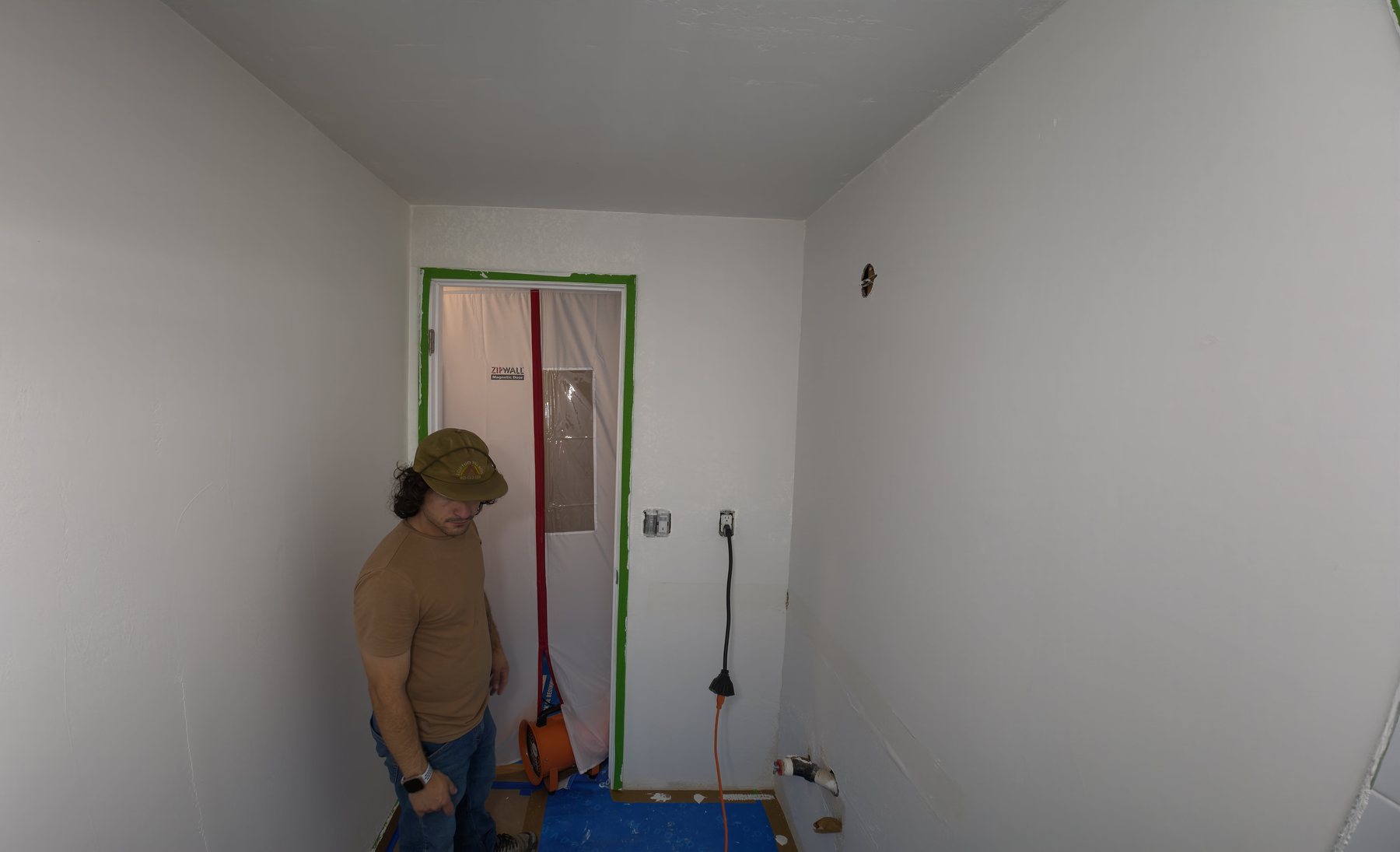
So the fourth time, we stopped asking about the bidet. We asked instead whether he wanted a dedicated outlet behind the toilet. The electrician was already there. The wall was already open. If he never wants a bidet, it is an outlet he never uses. If he changes his mind in four years, he buys a seat, clips it on, plugs it in.
He said yes in about five seconds. That question is on every bathroom we quote now, and everything below is what sits behind it.
The short answer
An electric bidet seat needs a dedicated outlet. A non-electric attachment needs nothing. Neither needs new plumbing. Both tee off the water line already feeding your toilet, which is the part almost everybody gets wrong.
So during a renovation the real question is not whether you want a bidet. It is whether you want the outlet sitting there in case you ever do. While the wall is open that outlet is a rounding error. Once the wall closes it is a job.
Don't decide about the bidet. Just put in the outlet. You can make the actual decision in four years. You cannot cheaply run the wire in four years.
What a bidet actually needs
Less than almost anyone assumes, and this is the misconception worth killing first. People picture a separate porcelain fixture against the wall, the kind you meet in European hotels. That is not what we are talking about.
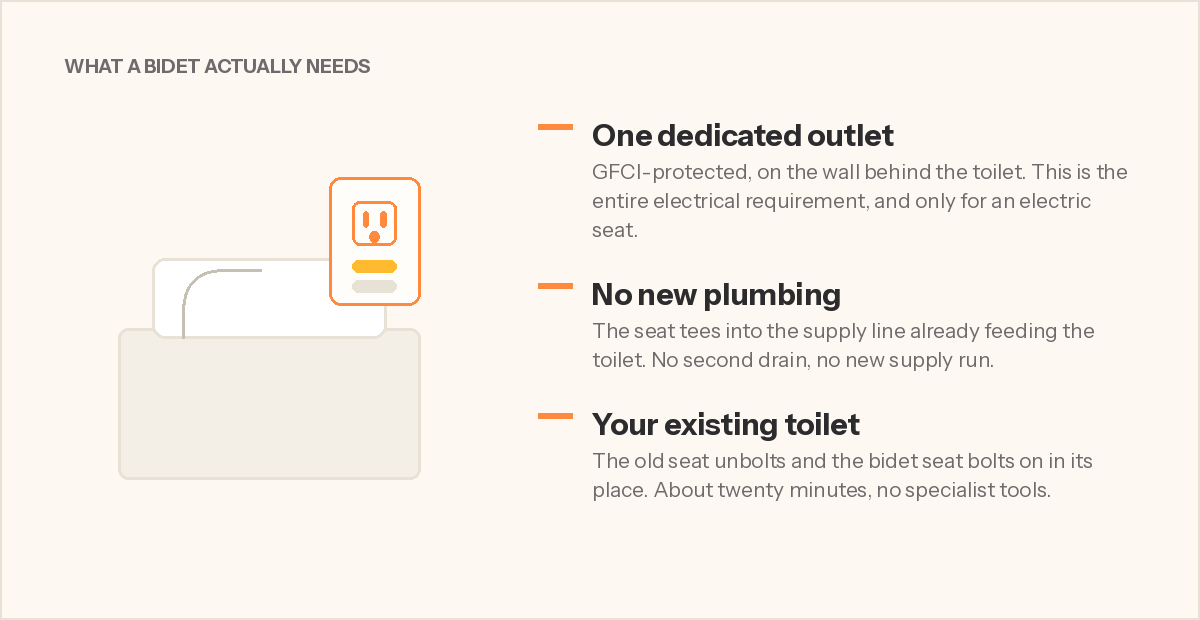
A bidet seat replaces the seat you already have. It connects to the toilet’s existing supply line with a tee fitting. No second drain, no new supply run, no change to the rough plumbing. It is not a fixture you add to the bathroom — it is a part of the toilet you already own.
What it does need, if it is electric, is power. Heated water, a heated seat and a dryer all draw current, and bathroom code requires that receptacle to be GFCI-protected. That is the entire electrical requirement: one dedicated, GFCI-protected outlet behind the toilet.
Bidet seat
Replaces your existing toilet seat entirely. Needs an electrical outlet because it heats the water, warms the seat and runs a dryer.
Bidet attachment
A thin plate that fits under your existing seat. No electricity, cold water only, and it costs about a tenth as much.
GFCI outlet
Ground-fault circuit interrupter — the shock-protection receptacle that electrical code requires near water. This is the outlet type a bathroom needs.
The two options
Electric bidet seat
Needs a dedicated GFCI outlet, and that is its only real requirement. No new plumbing, fits the toilet you already have, and about twenty minutes to put on yourself. Warm water, heated seat, dryer. This is the one if you are committing to the switch.
Non-electric attachment
Needs no outlet, no electrician and no plumbing. Also fits your existing toilet, and takes about fifteen minutes. Cold water only, and it costs a small fraction of what the seat does — which makes it the cheapest honest way to find out whether you like the idea before spending more.
Install times assume a competent DIY fit on a standard two-piece toilet. We do not quote seat prices here — they move, and you buy the seat yourself.
Where the cost actually sits
Not in the bidet. The seat is something you buy yourself whenever you feel like it, and fitting it is a twenty-minute job with no specialist tools and no trade involved.
The cost sits in the electrical work, and specifically in when that work happens. During rough-in, an electrician is already on site with the walls open. Adding one receptacle on the toilet wall is a small addition to work that is already scheduled.
After the bathroom is finished, that same outlet is its own project: an electrician’s visit, a circuit run through closed construction, then patching, texture and paint on a wall you just paid to finish. Identical outlet. Completely different number. That gap is the only reason this post exists.
When you do not need the outlet
Three cases where this does not apply
- You want a non-electric attachment. It runs on water pressure alone. No outlet, no electrician, and far less to buy.
- You are renting, or no bathroom work is planned. The whole argument rests on the wall already being open. If it is not, adding an outlet is its own job with its own cost, and we would not push you to do it.
- There is already a GFCI outlet behind the toilet. Some newer bathrooms have one. Check before paying for a second.
How we handle it now
Every bathroom we quote has a line for the outlet
We stopped asking clients whether they want a bidet. We ask whether they want us to leave them the option, which is a different question and gets a different answer.
- Every bathroom quote carries a line item for a dedicated GFCI outlet behind the toilet.
- You can decline it, and plenty of people do. There is no second ask.
- We raise it at the electrical walkthrough, when the wall is open and the cost is real and small.
We make nothing on this. The seat is something you buy online. We would rather you never call us in three years asking what it would take to add one and hear a number you do not like.
What else to settle while the wall is open
The outlet is one instance of a general rule, and the rule is the more useful thing to take away: everything inside a wall is cheap until the wall closes. While the framing is still open, these are worth ten seconds of thought each:
- Blocking for grab bars behind the shower and beside the toilet, even if you never fit them. Plywood between studs costs almost nothing and makes a future grab bar a ten-minute job instead of a wall repair.
- A niche in the shower wall, sized and placed before tile.
- Outlets inside the vanity for toothbrushes and shavers, so nothing trails across the counter.
- The exhaust fan run — correctly sized and vented outside, not into the attic.
None of these are upsells. They are all things that are trivial now and disruptive later.
Can you check this yourself?
Yes, in about ten seconds, and it is worth doing before you talk to anyone.
- Look at the wall behind and beside your toilet. Is there an outlet within reach of the seat?
- If there is, look at the outlet itself. Does it have TEST and RESET buttons? That is a GFCI, which is what a bidet seat needs.
- If there is no outlet, or the nearest one is across the room, then adding an electric bidet seat later means electrical work. That is the situation this post is about.
If a bathroom renovation is already planned, that is the moment to fix it. If one is not, a non-electric attachment sidesteps the question entirely.
Frequently asked questions
Do you need an outlet for a bidet?
For an electric bidet seat, yes. Heated water, a heated seat and the dryer all need power, and code calls for a GFCI-protected receptacle in a bathroom. Non-electric attachments need no power at all — they run on your existing water supply.
Is a bidet worth it?
For most people who try one, yes — the common report is that they do not go back. The honest caveat is that it is a preference, not a fact, and some people try one and stay indifferent. The low-risk way to find out is a non-electric attachment, which costs a fraction of an electric seat, before committing to the full version.
Does a bidet need separate plumbing?
No. A bidet seat or attachment tees into the water supply line already feeding your toilet. There is no second drain and no new supply run. This is the thing most people get wrong about them.
Can you add a bidet to an existing toilet?
Almost always. The old seat unbolts, the bidet seat bolts on in its place, and the supply line tees off the toilet fill valve. It is typically a twenty-minute job with no specialist tools. Check the seat fits your bowl shape — elongated or round — before buying.
How much does it cost to add an outlet behind the toilet later?
Considerably more than doing it during a renovation, because the wall is closed. You are paying for an electrician, running a new circuit through finished construction, then patching and repainting. During rough-in the same outlet is a small addition to work already happening. We are not quoting a figure here — ask us and we will price your actual bathroom.
Are non-electric bidet attachments any good?
They work, and they are the cheapest honest way to find out whether you like the idea. Cold water only, which some people never mind and others dislike immediately. Either way you learn something before spending more.
The takeaway
An electric bidet seat needs one dedicated GFCI outlet and no new plumbing. A non-electric attachment needs neither.
If a renovation is already happening, that outlet is a small addition to work already scheduled, and it removes the only expensive part of a decision you can then make whenever you like — or never. If no renovation is happening, this is not urgent and we are not going to pretend it is.
One last thing and then we will stop. Everyone at this company has a bidet. Not one of us has gone back. We are aware that makes us unreliable narrators, which is exactly why the recommendation here is not “buy a bidet” — it is “do not let anyone close a wall on the option.”
Planning a bathroom this year? Ask whoever is doing it to run an outlet behind the toilet. Us or not us. It is twenty minutes of an electrician’s day and it keeps a door open.
Explore Recent Posts

Why Americans never used bidets, and why that is changing
How to Choose the Right Contractor in Seattle: It Goes Both Ways