
Mushroom in the Shower? What a Wood Mat Did to the Pan
A mushroom grew at a shower curb. The cause was a wood mat holding water on the pan. What we found, and seven things to check in your own shower.


The call was about a mushroom. It had come up at the base of a walk-in shower in a Columbia City home, right where the floor meets the curb. The homeowners pulled it out, then wondered what a mushroom was doing in a bathroom at all.
Angelo went to look. We did not open anything. We found the cause sitting on the shower floor, and it was something the homeowners had bought to make the shower nicer.
They found us through a post we wrote about a different shower. That is the reason for this one. Every leak we look at turns out to be its own case, so we write each one down. If the details help you work out your own shower without calling anyone, the post has done its job.
What the homeowners noticed
- A mushroom growing at the shower curb. They removed it before we came, so there is no photo of it.
- A slatted wood mat on the shower floor, in use for about six to eight weeks. The mushroom showed up after the mat did.
- A bathroom fan that runs most of the day.
- No stains on the ceiling of the room below. They had already checked.
How we looked
This was a look-and-measure visit. Nothing was cut and no tile came off. We asked how the shower gets used, looked closely at the floor, the joints and the grout, scanned the floor and walls with a thermal camera, and took humidity and temperature readings in the room. We also made a 3D scan of the bathroom so we could study the layout later.
We arrived about four hours after the last shower. That timing turned out to matter.
How a shower pan is supposed to work
A shower pan is the floor of the shower. It slopes to a drain, so water leaves in minutes. Where the wall tile meets the pan there is a joint, sealed with caulk. That joint gets splashed every day, and it is built for that. It is not built to sit in water.
Tile and grout are the finish, not the waterproofing. Behind them is a backer board, and behind that is the wood framing of the wall. Neither should ever see water.
The model below plays on its own. It opens the shower up into its layers, puts it back together, and then walks through what a mat can do to it. Drag it to look from another side.
A simplified model of a walk-in shower, not a measured drawing. The south wall is cut low so you can see inside.
What we found
1. Water was still on the floor four hours after the shower. The mat covered nearly the whole pan. It stopped about three inches short of the edge on every side, and it sat right over the drain. Under it, the floor was wet. The surface felt slippery and the shower smelled musty. A shower floor with nothing on it is normally dry long before four hours.
2. The drain was working. This is the part that surprised the homeowners. Water was not backing up. The thermal camera showed the area around the drain warmer than the edges of the floor, which fits water running to the drain and leaving. The slope was doing its job. The mat was keeping air off the floor, so the thin film of water left behind after each shower never dried.
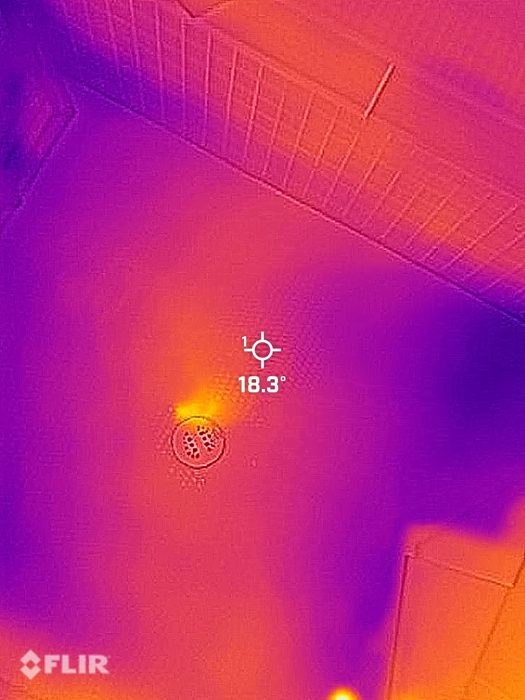
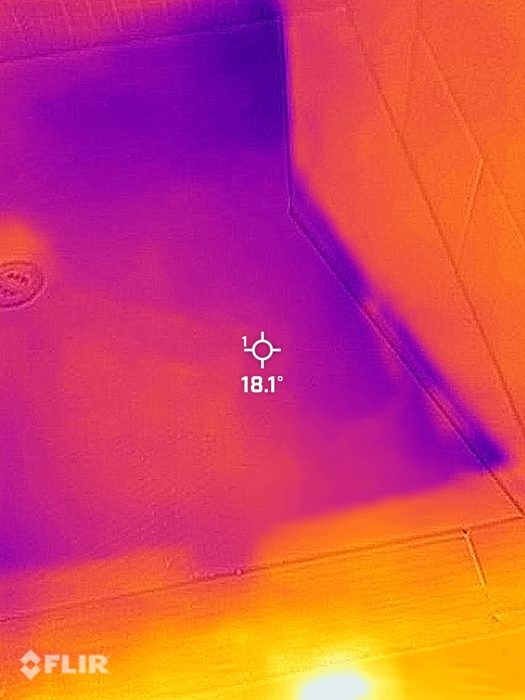
3. The edges were the wettest part. A thermal camera only shows surface temperature. Wet surfaces usually read cooler, because the water is evaporating. The shower floor read cooler than the walls, and coolest where the floor meets the walls. Spot readings ran from about 63 to 67 °F.
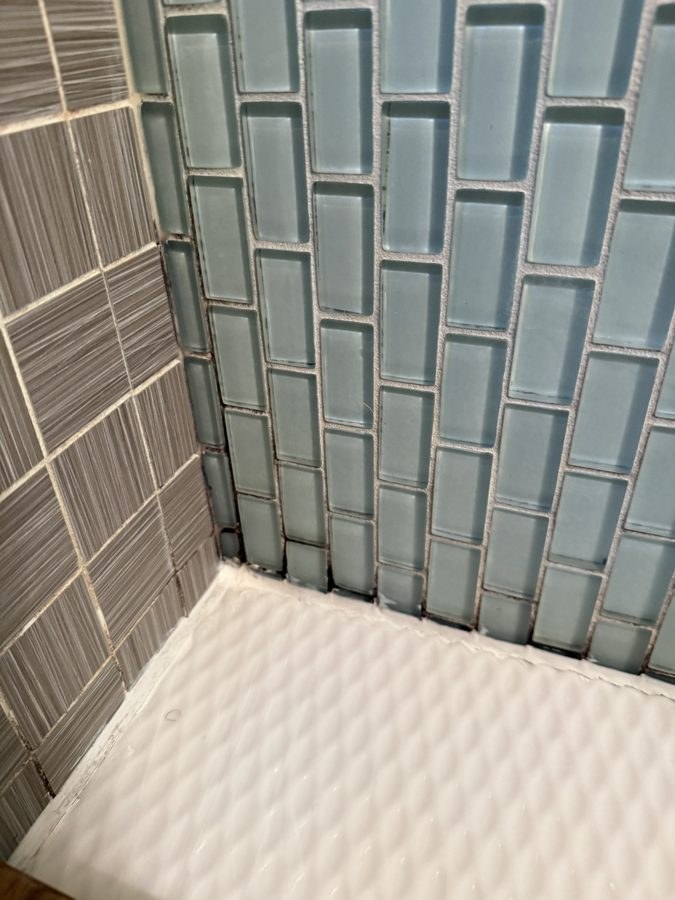
4. The joint and the bottom rows of grout had given way. The caulk between the wall and the pan was uneven, with gaps. The grout in the lowest rows of glass mosaic had gone dark, most heavily in one corner. It looks like mold or mildew in the grout, and possibly behind it. We did not test it, so we cannot say what kind it is or how far back it goes.
5. The room was staying humid. Our air sensor read 66% relative humidity four hours after a shower, with the fan running. A second reading later in the visit said the same. A bathroom that is still in the mid 60s hours later is not drying out between showers.
So why a mushroom?
A mushroom is the last stage of a fungus, not the first. Before one appears, the fungus grows as a web of fine threads in something that stays damp. That takes time. So a mushroom at the curb tells you that spot had been damp for a good while before anything was visible.
Spores are in outdoor air all the time. This bathroom has a window and there is a tree close to the house, so a spore drifting in is a likely source. We cannot prove where it came from, and we did not identify the species. What we can say is that the curb had what a fungus needs: standing water, humid air and weeks without drying.
Here is the same story from the side.
What we could not tell
- Whether the wood framing behind the wall or under the pan is damaged. Nothing we saw confirms it, and nothing rules it out.
- Whether any water is getting past the pan or the drain connection.
- How far the staining goes behind the mosaic.
A thermal image suggests where moisture is. It does not confirm it. The honest answer after one visit is that the cause is clear and the extent is not.
What we got wrong
We said "black mold" out loud in the bathroom before anything had been tested. Dark staining in grout is very often mold or mildew, but nobody can name the type by looking, and we should not have.
We also left our moisture meter on another job that morning. A thermal camera and a moisture meter belong together, because one points and the other confirms. Without the meter, every cold spot we found is a suspect and not a finding. And we read the humidity aloud as 62 to 64% on site. The photo of the sensor says 66%. The 62 was the temperature.
What you can check in your own shower
- Time how long the floor takes to dry. After a shower, look at the floor an hour later. If it is still wet, something is holding water: a mat, a low spot or a slow drain.
- Lift anything that lives on the floor. Mats, teak platforms, caddies and bottles all trap a film of water. Stand a mat on its edge after every shower so both it and the floor can dry. If the underside is slimy or dark, it has been staying wet.
- Keep the drain uncovered. A mat over the drain does not always block it. It can still keep the lowest part of the floor from ever getting air.
- Look at the bottom two rows of grout. That is where water sits longest. Grout that is darker there than higher up the wall is telling you the base of the wall stays damp.
- Press on the caulk line. Caulk that is cracked, peeling or pulling away from the pan lets water behind it.
- Check the room, not just the shower. A small humidity sensor costs very little. If the bathroom is still above about 60% an hour after a shower, the fan is not keeping up. Let it run longer, crack the window, and find out whether the fan actually vents outdoors.
- Trust your nose. A musty smell that comes back a day after cleaning usually means something stays wet where you cannot see it.
What fixes it, and what only hides it
The first step is free. Take the mat out and let the shower dry. In a case like this we would help it along with a dehumidifier, a heater and a fan for a few days, and measure the corners before and after so we know whether the materials behind the tile have dried.
New caulk is the repair most people reach for, and it has a place. On its own it is a short-term fix here. It seals the surface of one joint. It does nothing for growth already in the grout, and grout is porous, so water still gets through the rows above the joint. Caulk put over materials that are still damp traps that moisture behind it.
The longer-lasting repair is to take out the affected tile, look at what is behind it, and rebuild that area as one continuous sealed surface with no grout lines for water to work through. If the material behind the tile is damaged, the plan changes, and it is better to find that out with one corner open than after the whole shower is finished again.
If your own shower shows staining or loose grout without a mat in the picture, the cause may be different. We wrote up a shower pan that pooled water because of its slope, a guide to spotting water behind shower tile, and the warning signs of mold behind tile. For the health side, which is not our field, start with mold and your health in a Seattle home. And if you are curious about the continuous-surface repair, here is a mosaic shower pan resurfaced with microcement.
If you have tried the checks above and something still does not add up, we do this kind of look-and-measure visit in Columbia City and across Seattle. You can reach us at (206) 413-8156.
Questions homeowners ask us
Is a mushroom in the shower dangerous?
We are builders, not doctors, so we will not answer the health question. What a mushroom does tell you is practical: that spot has stayed wet for weeks. Remove it, and then find out why the area is not drying.
Can I keep using a wood mat in my shower?
Yes, with a habit change. Stand it up or hang it after each shower so the floor and the underside both dry. Pick one that leaves the drain and the edges of the floor open. A mat that stays down all week turns a shower floor into a damp cupboard.
Will new caulk fix dark grout at the bottom of my shower wall?
Not by itself. Fresh caulk seals one joint. The dark grout above it is already holding moisture, and grout lets water pass. Dry the area fully first, clean or replace the stained grout, and then seal. If the stain returns quickly, water is reaching it from behind.
How do I know if the leak has reached the wood?
You usually cannot tell from the tile side. Look at the ceiling below the shower, press on the floor outside the curb for soft spots, and note any smell that will not go away. A moisture meter on the surrounding walls gives a real reading. Beyond that, someone has to open a small area and look.
Explore Recent Posts
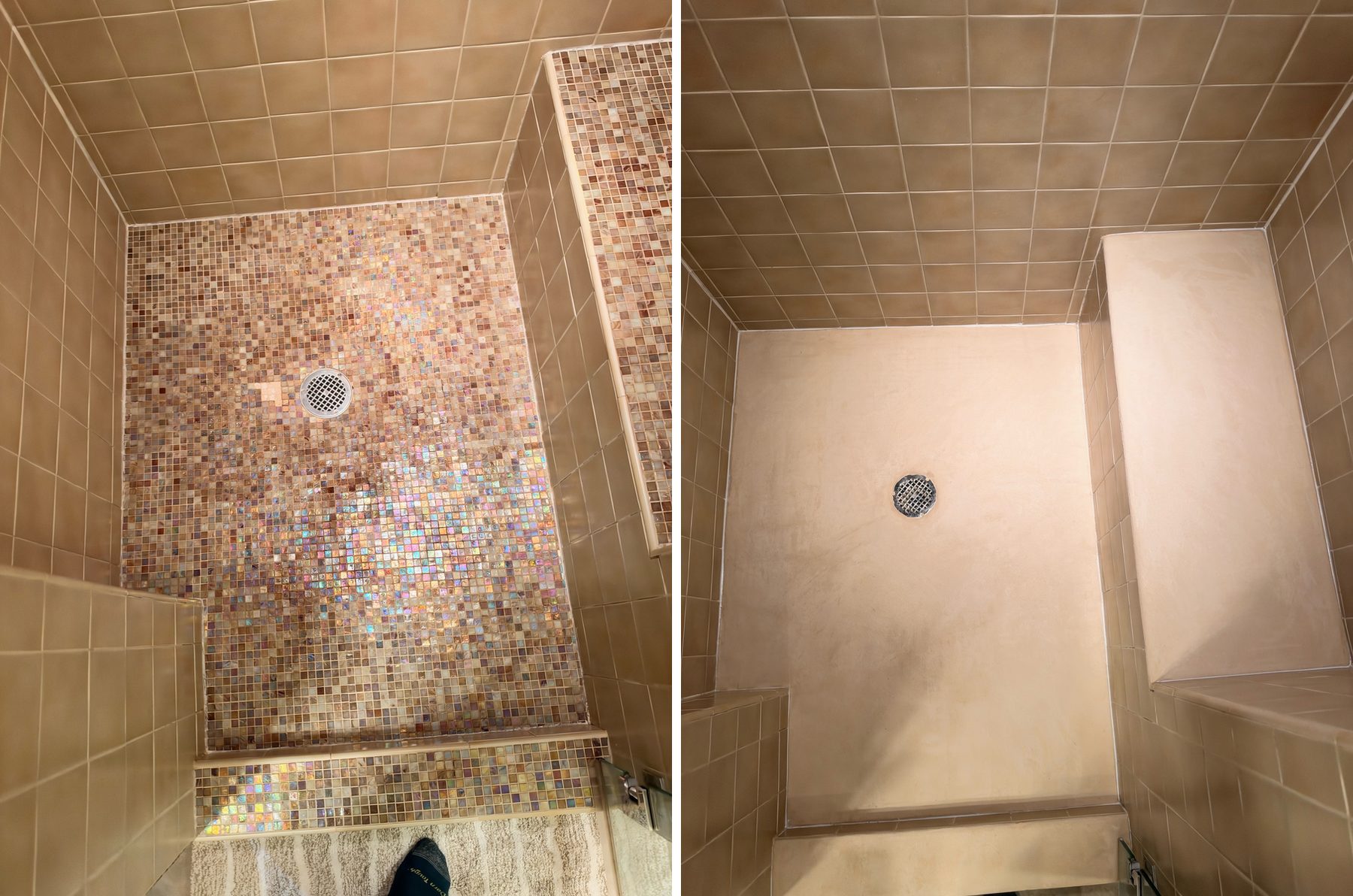
Resurfacing a Seattle Mosaic Shower Pan With Microcement

Failing Shower Pan? What Odor, Pooling and Loose Grout Mean